
What if the most important feature of a multi-chain wallet is not the number of networks it supports, but the quality of the question it asks before you sign? In DeFi, a transaction can look familiar while quietly granting a contract broad control over tokens, routing funds through an unexpected chain, or interacting with an address that only resembles the one you intended to use. This is why a wallet such as Rabby deserves to be assessed less as a convenient account manager and more as a verification layer between the user and complex smart-contract systems.
For users in Germany and elsewhere in the European crypto market, that distinction matters. Self-custody means retaining control of private keys, but it also means retaining responsibility for approvals, browser security, backups, and signing decisions. A multi-chain wallet can reduce operational friction, especially across Ethereum, Polygon, Arbitrum, Optimism, Avalanche, Base, and the BNB Chain. It cannot remove the underlying risks of bridges, decentralized applications, compromised websites, or human error. The useful question is therefore not whether a wallet is “safe” in the abstract, but which risks it can expose, which it can reduce, and which remain outside its reach.
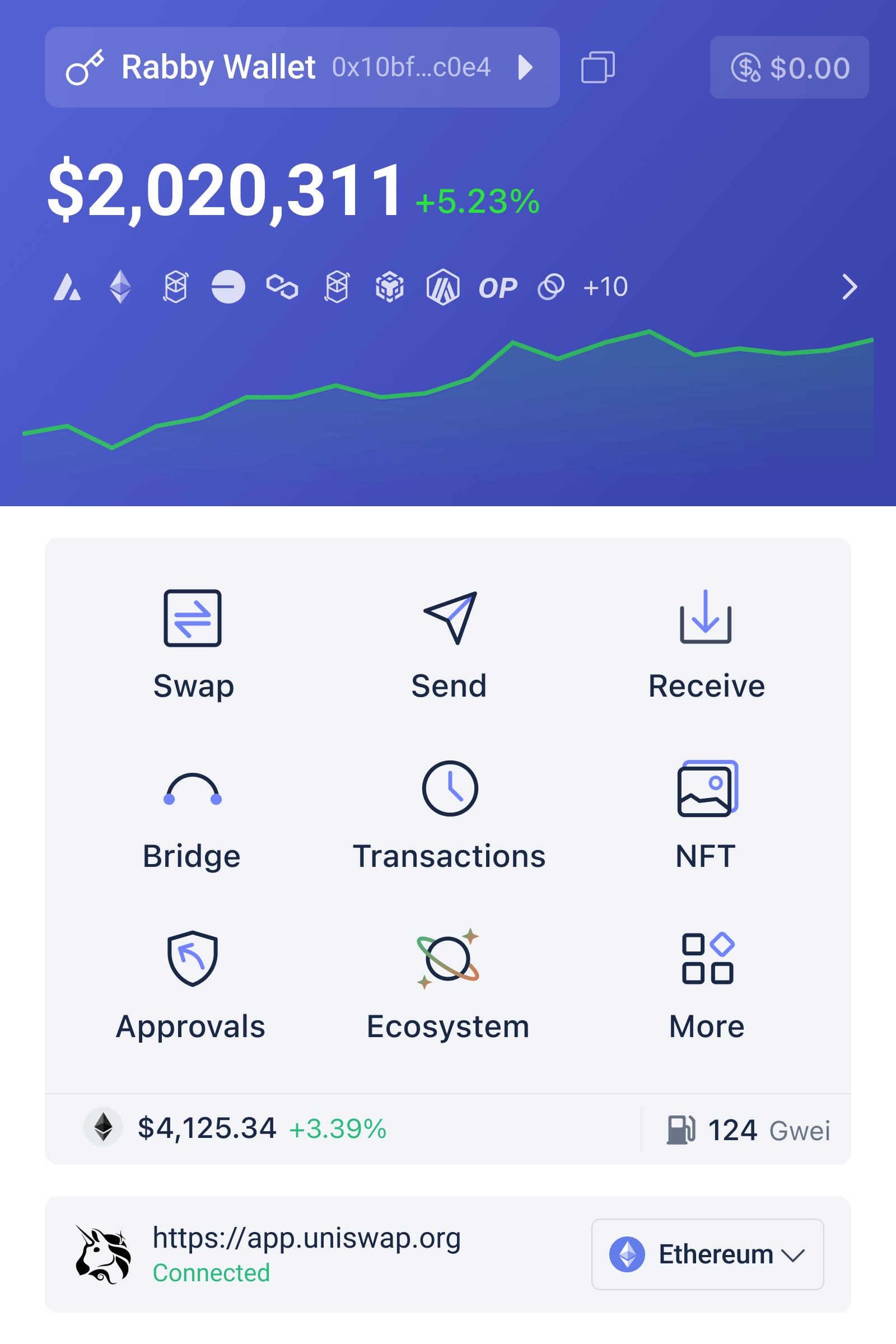
The first misconception: a wallet does not make a transaction safe
A crypto wallet generally holds or controls the credentials needed to authorize blockchain actions. In a non-custodial design, private keys are stored locally on the user’s device rather than being handed to the wallet provider. Rabby follows this model, and its signing functions are designed to remain available even if Rabby’s own backend services become unavailable. That separation is important: the wallet does not need to create or alter a user’s transaction in order to present it for signing.
But non-custodial does not mean risk-free. If a user signs a malicious approval, the blockchain may execute it exactly as requested. If a seed phrase is exposed, local key storage offers no protection against someone who has obtained the phrase. If a bridge protocol is exploited, a wallet interface cannot reverse the resulting on-chain loss. Security software can improve visibility; it cannot replace judgment or change the finality of most blockchain transactions.
Rabby’s security model addresses this gap through several checks before confirmation. Its integrated security engine can examine contracts and addresses for signals associated with phishing, known hacks, or unlimited token approvals. Its transaction simulation is particularly useful because it attempts to show the expected changes to token balances before signing. This translates opaque contract logic into a more practical question: what will leave my wallet, what will arrive, and what permissions will change?
That is a meaningful improvement over blindly approving a transaction, but simulation has a boundary. It is an estimate based on the state and behavior available at the time of simulation. A contract may depend on changing market prices, external calls, block timing, liquidity conditions, or state changes that occur before inclusion. A simulated swap can also be economically unattractive even when it is technically successful. Users should treat the result as a powerful warning and preview system, not as a guarantee of execution or profit.
Why multi-chain convenience changes the risk equation
Rabby is built for EVM-compatible networks and supports more than 140 chains and networks, including widely used Ethereum layer-two and alternative-chain environments. Automatic network switching can remove a common source of friction: the user connects to a decentralized application, and the wallet detects the network the application requires. This is convenient, especially for people moving between protocols in Germany’s increasingly multi-chain DeFi environment.
Convenience, however, changes what deserves attention. Manual network selection creates friction but also forces the user to notice where an action is taking place. Automatic switching reduces that pause. The practical safeguard is to make chain identity part of the signing routine. Before confirming, check the network, the application domain, the asset, the recipient, the approval scope, and the expected balance change. A wallet that hides unnecessary complexity is useful; a user who stops checking context is exposed to a different kind of error.
Bridges illustrate this trade-off clearly. Rabby integrates bridge protocols such as LI.FI, allowing users to move assets across networks from within the wallet interface. This can simplify route discovery and reduce the need to visit unfamiliar websites. Yet a bridge transaction may involve several contracts, liquidity providers, relayers, and settlement steps. The visible interface may be simple while the underlying route is not. A better route price can also come with different trust assumptions, execution delays, or smart-contract exposure.
The same principle applies to the integrated swap aggregator, which can scan decentralized exchanges such as Uniswap and 1inch for pricing and potentially lower slippage. Aggregation improves search, but “best rate” is never the same as “lowest total risk.” Price impact, approval permissions, routing contracts, gas costs, failed transactions, and the quality of available liquidity all matter. The decision is not merely which quote is largest on screen; it is whether the route is understandable and acceptable for the amount being traded.
Security is a workflow, not a warning banner
The most useful mental model is to treat a DeFi wallet as a workflow for reducing avoidable mistakes. Rabby’s scanner and simulation add information at the point where information matters most: immediately before signing. Hardware-wallet compatibility with Ledger, Trezor, and OneKey adds another layer by keeping key operations behind a separate device. This can substantially improve protection against some forms of malware and unauthorized browser activity, although it does not make a user immune to social engineering or deceptive transaction content.
For higher-value activity, a sensible routine is to separate roles. A hardware wallet can hold long-term assets, while a smaller hot-wallet balance can be used for experimental applications. Test transactions can reveal whether an address, chain, and amount are correct. Token approvals should be reviewed rather than treated as a one-time technical detail. When a protocol requests an unlimited approval, the convenience benefit should be weighed against the possibility that the contract could later spend more than the immediate transaction requires.
Rabby’s open-source architecture, released under the MIT license, creates an opportunity for independent community review of the code. That is a valuable transparency property, but it should not be confused with a permanent security certificate. Open-source code can still contain defects, dependencies can fail, releases can introduce changes, and users may install counterfeit extensions from unofficial sources. Download provenance, browser hygiene, operating-system updates, and seed-phrase protection remain part of the security perimeter.
Local key storage also requires a realistic understanding of responsibility. The provider does not receive the private key, which limits the provider’s role in custody and means there is no central password reset for a lost recovery phrase. A backup must be stored securely and kept private. In practice, many self-custody losses arise not from sophisticated cryptography breaking, but from phishing, malicious signing, leaked recovery data, or an irreversible transfer to the wrong address.
Gas abstraction helps, but it can hide another dependency
Cross-chain operations often fail for an ordinary reason: the user has the asset they want to move but lacks the native token needed to pay network fees. Rabby’s Gas Account feature allows supported fees to be paid across networks with stablecoins such as USDC. This is a practical improvement because it reduces the need to maintain small balances of many native tokens.
The trade-off is that fee abstraction introduces an additional service and conversion path. Users should understand the applicable fees, supported networks, settlement conditions, and what happens if the service is unavailable. Paying gas in a stablecoin is a usability feature, not a removal of network economics. Congestion, liquidity, smart-contract risk, and asset-specific restrictions still exist. The feature is most useful when it solves a genuine operational problem without encouraging users to stop checking which network and mechanism are being used.
Rabby Points, earned through activities such as swaps, gas top-ups, or referrals, add a loyalty layer to the product. Such incentives may encourage exploration, but they also create a behavioral risk familiar from many financial applications: users may transact more often because activity is rewarded. Points should therefore be treated as optional program benefits, not as a reason to accept unnecessary fees, approvals, bridge exposure, or market risk.
What to watch as wallets become more intelligent
Recent project positioning presents Rabby as a broad Ethereum and EVM wallet with a focus on speed, security, and on-chain activity. The more interesting development is not the slogan itself, but the direction it signals: wallets are becoming interpretation tools. They increasingly summarize contract effects, identify suspicious patterns, choose routes, and automate network selection. If these systems become more accurate and transparent, they could make advanced DeFi more accessible to non-specialists.
The open question is how much users will delegate without understanding. A warning engine may reduce losses from known phishing patterns, but new exploits and adversarial contracts can fall outside its knowledge. A simulation can show expected balances while leaving economic risk, governance risk, or protocol solvency unresolved. The likely future boundary is therefore between mechanical verification, which software can improve, and judgment about trust, incentives, and acceptable loss, which still belongs to the user.
For someone evaluating a DeFi wallet, a reusable framework is simple: ask what is being protected, what is being observed, and what remains assumed. Local keys address custody assumptions. Hardware signing addresses some device and browser threats. Simulation addresses transaction visibility. Scanning addresses known warning signals. None of these automatically validates the protocol’s governance, the bridge’s solvency, the token’s value, or the legitimacy of a website reached through a search result. Those categories should not be collapsed into one general label of safety.
Users who want to examine the extension and its multi-chain workflow can explore rabby wallet as part of their own due diligence. The practical standard should be higher than installing a popular tool: verify the official source, start with a small amount, use hardware protection for meaningful balances, and read the simulated outcome before every unfamiliar signature.
FAQ: Rabby Wallet and DeFi security
Does transaction simulation guarantee that a DeFi transaction is safe?
No. Simulation can clarify expected token and approval changes and may expose suspicious behavior before signing. It cannot guarantee that market conditions, contract state, routing, or external dependencies will remain unchanged when the transaction is executed. It also cannot prove that a protocol is economically sound.
Is Rabby safer than every other crypto wallet?
That conclusion would be too broad. Rabby offers features that can improve visibility for multi-chain DeFi, including simulation, security warnings, hardware-wallet support, and automatic network handling. Actual safety depends on the wallet version, installation source, device security, user behavior, protocol choice, and the amount exposed in the account.
Can a hardware wallet prevent a malicious DeFi transaction?
A hardware wallet helps protect the private key and requires physical confirmation, but it may still sign a harmful transaction if the user approves what appears on the device or in the wallet workflow. Hardware security is strongest when combined with address verification, transaction review, limited approvals, and a separate account for experimentation.
The central lesson is deliberately less dramatic than a promise of perfect protection: a strong DeFi wallet improves the quality of the decision immediately before signing. That matters enormously across many chains, but the final security boundary remains the user’s ability to recognize what the transaction is allowed to do.